Is Meditation Actually Beneficial? (Let’s Dig Into the Truth)
Let’s be real for a second. Everywhere you look these days—social media, podcasts, magazines—someone is talking about meditation. It feels like the whole world is sitting cross-legged, closing their eyes, and finding “inner peace.”
For some, it sounds like a miracle cure. For others, it sounds like a trendy buzzword that will disappear in a few years. You might be thinking, “Is sitting silently for ten minutes really going to change my life, or is this just hype?”
It is a fair question. With life being as busy as it is, nobody wants to waste time on something that doesn’t work.
So, let’s cut through the noise. Is meditation actually useful? Does it really do anything for your brain? The short answer is: Yes. But probably not in the way you think.
Research shows that when done correctly and consistently, meditation is like a gym workout for your mind. But let’s break down why and how it helps, without using complicated spiritual jargon.

What Exactly Is Meditation? (Spoiler: It’s Not Just for Monks)
First, let’s clear up a misconception. You don’t need to be a monk living on a mountaintop to meditate. You don’t need to burn incense or chant mantras (unless you want to).
At its core, meditation is simply the practice of training your attention.
Think of your mind like a puppy. It runs around, chases squirrels, barks at nothing, and gets into trouble. Meditation is the process of gently teaching that puppy to sit and stay.
It usually involves:
- Finding a quiet spot to sit.
- Focusing on one thing (usually your breath).
- Noticing when your mind wanders (because it will wander).
- Bringing your attention back.
That’s it. It is a mental exercise. Just like you do bicep curls to build arm strength, you do meditation to build “focus strength.”
The Real-Life Benefits: Why Should You Care?
Okay, so we know what it is. But what does it actually do for you? Here are the biggest benefits backed by science (and real people’s experiences).
1. It Hits the “Pause” Button on Stress
We live in a world that never stops. Notifications, deadlines, traffic, bills—our bodies are constantly in “fight or flight” mode. This floods our system with stress hormones like cortisol.
Chronic stress is like leaving a car engine running in the garage; eventually, the fumes will make you sick.
How meditation helps: Regular practice triggers the body’s “relaxation response.” It literally lowers cortisol levels. It doesn’t make your problems disappear, but it changes how you react to them. Instead of exploding when you spill coffee, you might just sigh and wipe it up. It gives you a buffer zone between the event and your reaction.
2. It Tames the “Monkey Mind” (Anxiety)
Do you ever lay in bed at night replay a conversation from 2013? Or worry about a meeting that is three weeks away? That’s anxiety. It’s the mind living in the past or the future.
Meditation forces you to be in the present.
When you focus on your breath right now, you can’t be worrying about tomorrow. By practicing this, you teach your brain to step off the hamster wheel of worry. It’s like a cooling balm for an overheated brain.
3. It Upgrades Your Focus
Let’s be honest: our attention spans are shrinking. We scroll through Reels and TikToks, switching context every 15 seconds. We have forgotten how to do one thing at a time.
Meditation is essentially “focus training.”
The result?
- You can read a book without checking your phone every page.
- You can finish a work task faster.
- You feel less scattered and more “locked in.”
4. It’s a Natural Sleep Aid
If you have insomnia, you know the struggle. Your body is tired, but your brain is running a marathon.
Meditation helps relax the physical body and quiets the racing thoughts. There are specific “sleep meditations” (often called Yoga Nidra) that are incredibly effective at shutting down the mental noise so you can drift off. It’s much healthier than doom-scrolling until you pass out.
5. It Boosts Your Mood (Emotional Intelligence)
Have you ever felt grumpy for no reason? Meditation helps you become more self-aware. You start to notice your emotions before they hijack you.
Instead of saying, “I am angry,” you learn to say, “I am feeling anger right now.” It sounds like a small difference, but it’s huge. It gives you control over your feelings rather than letting your feelings control you.
Does It Work for Everyone?
Here is the honest truth: Meditation is not a magic pill.
It’s not like taking a headache medicine where you feel better in 20 minutes. It’s more like eating vegetables or going to the gym. One salad won’t make you healthy, and one meditation session won’t make you enlightened.
- Some people feel calm immediately.
- Others feel frustrated and bored at first.
Both are normal. If you try it once and say, “I can’t do this, my mind is too busy,”—congratulations, you are human! The whole point of meditation is to notice that busy-ness. It works for almost everyone if they stick with it for a few weeks.
How to Start (Without Making It Complicated)
You don’t need an app, a subscription, or a special cushion. You just need yourself. Here is a simple “dummy’s guide” to starting:
- Time: Start small. Seriously, 5 minutes is enough. Don’t try to do 30 minutes on day one; you will hate it.
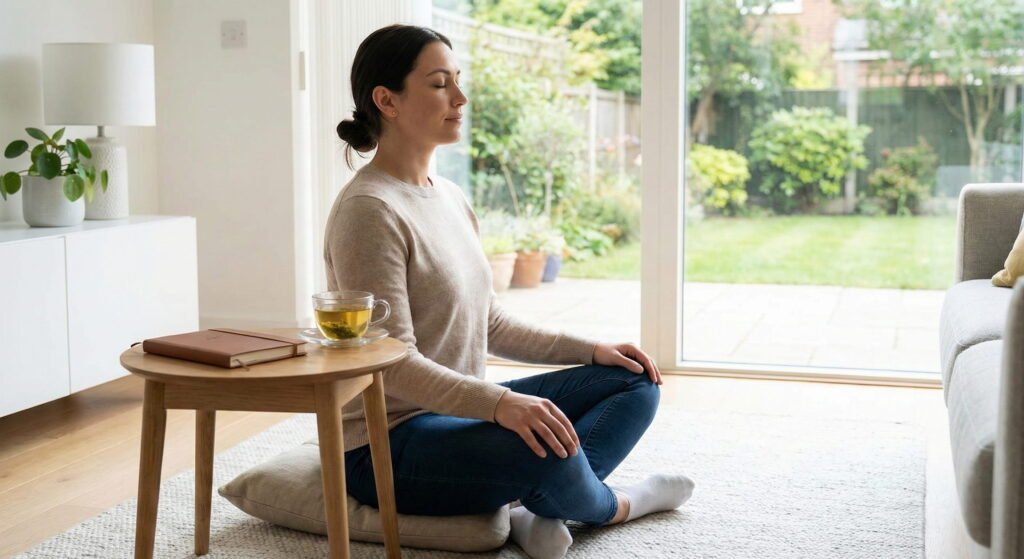
- Place: Find a chair or a spot on the floor where you won’t be disturbed.
- Posture: Sit comfortably with your back straight. You don’t need to twist your legs into a pretzel. Just sit up straight so you don’t fall asleep.
- The Anchor: Close your eyes and bring your attention to your breathing. Feel the air going in and out of your nose.
- The Return: Here is the secret sauce. Your mind will wander to your grocery list or an email. When you notice that happening, don’t get mad. Just gently bring your focus back to the breath.
That moment—when you notice you drifted and you come back—that is the “bicep curl” for your brain.
Common Myths You Should Ignore
- Myth: “I have to stop thinking.”
- Fact: Impossible. The brain thinks; that’s its job. You are just learning to observe the thoughts without getting lost in them.
- Myth: “It takes too much time.”
- Fact: Do you have 10 minutes to scroll Facebook? Then you have time to meditate.
- Myth: “I’m doing it wrong.”
- Fact: If you are sitting and trying, you are doing it right.
When Should You Seek Professional Help?
While meditation is powerful, it is not a replacement for medical treatment.
If you are suffering from:
- Severe depression
- Debilitating panic attacks
- Trauma or PTSD
Please do not rely only on meditation. Sometimes, sitting in silence with trauma can be difficult. In these cases, meditation should be done under the guidance of a therapist or doctor, alongside other treatments. It is a tool in the toolbox, not the whole toolbox.
The Bottom Line
So, is meditation really beneficial? Absolutely.
It is one of the simplest, cheapest, and most effective ways to improve your quality of life. It helps you sleep better, stress less, and actually enjoy the moments you are living in.
But don’t take my word for it. Try it. Give yourself 10 minutes a day for a week. You might just find that a little bit of silence is exactly what you’ve been looking for.
Start small, be patient with yourself, and breathe.
⚠️ Disclaimer:
This article is for general informational and educational purposes only. It is not intended to be a substitute for professional medical advice, diagnosis, or treatment. Always seek the advice of your physician or mental health professional with any questions you may have regarding a medical condition.