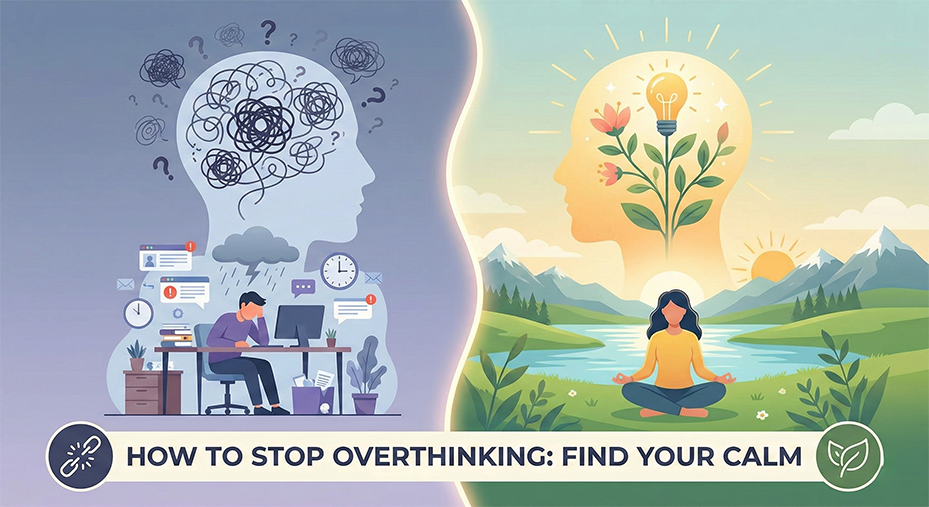
We all think. Planning for the future, solving problems, or reflecting on our day are all healthy mental processes.
However, when a single thought plays on a loop in your head, when you analyze a situation until you feel paralyzed, or when your mind refuses to switch off at night—that is overthinking.
Overthinking doesn’t just waste time; it drains your energy, spikes your stress levels, ruins your sleep, and damages your physical health. If you feel like a prisoner in your own mind, you are not alone.
In this guide, we will explore why we overthink and share 9 highly effective ways to break the cycle and find your calm.

Why Do We Overthink?
Before you can stop overthinking, it helps to understand why your brain does it. Common triggers include:
- Fear of the Future: Anxiety about “what ifs” and worst-case scenarios.
- Past Regrets: Ruminating on past mistakes or replaying conversations, wishing you had said something different.
- Self-Doubt: Constantly questioning your abilities or decisions.
- The Illusion of Control: Believing that if you just think about a problem long enough, you can prevent bad things from happening.
9 Ways to Stop Overthinking and Regain Your Peace
1. Do a “Brain Dump” (Write It Down)
When thoughts are bouncing around in your head, they feel massive and overwhelming. Take a piece of paper and write down exactly what you are worrying about. Ask yourself: What is the absolute worst that could happen? What is actually likely to happen? Seeing your thoughts on paper takes away their power and brings clarity.
2. Separate What You Can and Cannot Control
Overthinkers often obsess over things entirely outside their control (like other people’s opinions or the economy). Draw a line. Ask yourself, “Is this in my control?” If it is not, consciously practice letting it go. Focus 100% of your energy only on the actions you can actually take today.
3. Schedule “Worry Time”
This sounds counterintuitive, but it works. Give yourself 15 minutes a day (e.g., at 4:00 PM) specifically dedicated to worrying. If an anxious thought pops into your head at 10:00 AM, tell yourself, “I will worry about this at 4:00 PM.” This prevents overthinking from hijacking your entire day.
4. Ground Yourself with Deep Breathing
Overthinking triggers your body’s “fight or flight” stress response. You can hack your nervous system by changing your breath. Sit quietly for 5 minutes. Breathe in slowly through your nose, focus entirely on the feeling of the air filling your lungs, and exhale slowly. This forces your brain to stay in the present moment.
5. Move Your Body
You cannot always think your way out of a thinking problem; sometimes, you have to move your way out. Going for a brisk walk, doing a quick workout, or even stretching changes your physical state and breaks the mental loop. Movement clears the mental fog.
6. Challenge Your Thoughts (Think Realistically)
Overthinkers are masters at catastrophizing (imagining the worst-case scenario). When a negative thought arises, put it on trial. Ask yourself: “What actual evidence do I have that this bad thing will happen?” Usually, you will find that your fears are based on emotion, not facts.
7. Prioritize Sleep and Nutrition
A tired brain is an anxious brain. Sleep deprivation heavily limits your ability to regulate your emotions and stop repetitive thoughts. Ensure you are getting 7-8 hours of sleep and eating a balanced diet to keep your mental foundation strong.
8. Practice Self-Compassion
To err is human. Overthinkers tend to beat themselves up over every tiny mistake. Instead of being your own harshest critic, talk to yourself the way you would talk to a best friend. Be gentle. Forgive yourself for not being perfect.
9. Speak It Out Loud
Sometimes, keeping thoughts locked inside your head makes them toxic. Talk to a trusted friend, partner, or family member. Often, simply saying your worries out loud helps you realize that they aren’t as big or scary as they seemed in your mind.
When Should You Seek Professional Help?
If overthinking has crossed the line into chronic anxiety, it is time to seek help. Consult a mental health professional if:
- Your overthinking disrupts your daily life, work, or relationships.
- You are experiencing severe insomnia.
- You develop physical symptoms like heart palpitations, headaches, or chronic stomach issues.
- You feel a constant sense of dread.
Conclusion
Stopping overthinking is not an overnight fix; it is a habit you have to build gradually. By practicing journaling, deep breathing, and challenging your negative thoughts, you can slowly train your brain to let go. Be patient with your mind. You don’t have to figure everything out today.
⚠️ Disclaimer:
This article is for general informational and educational purposes only. It is not intended to be a substitute for professional medical advice, psychiatric diagnosis, or treatment. If you are struggling with severe anxiety or depression, please seek guidance from a qualified mental health professional.