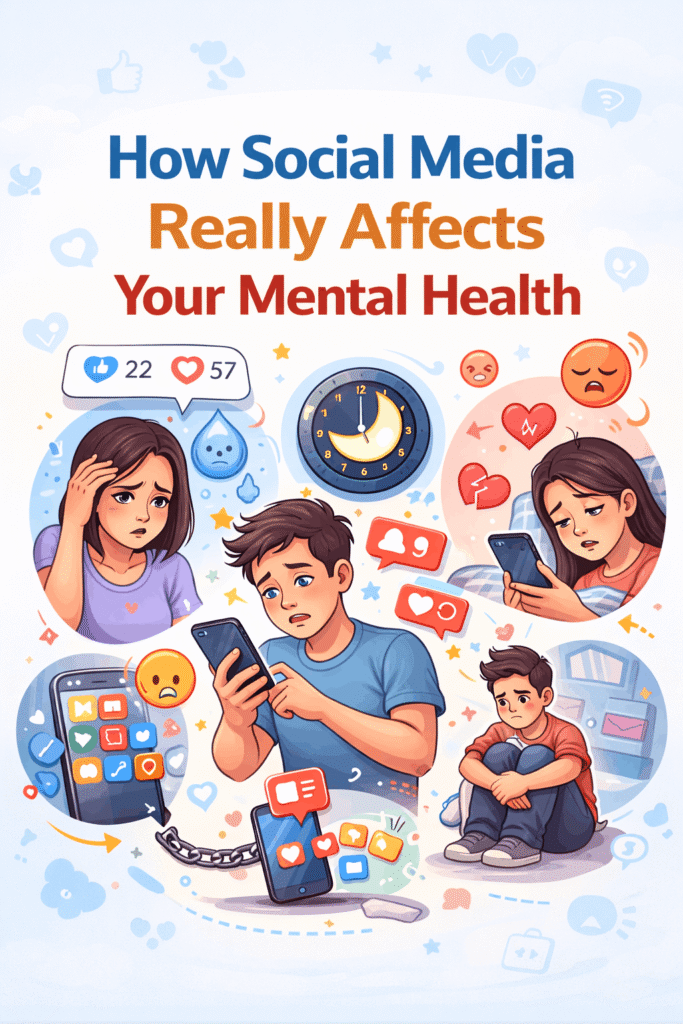
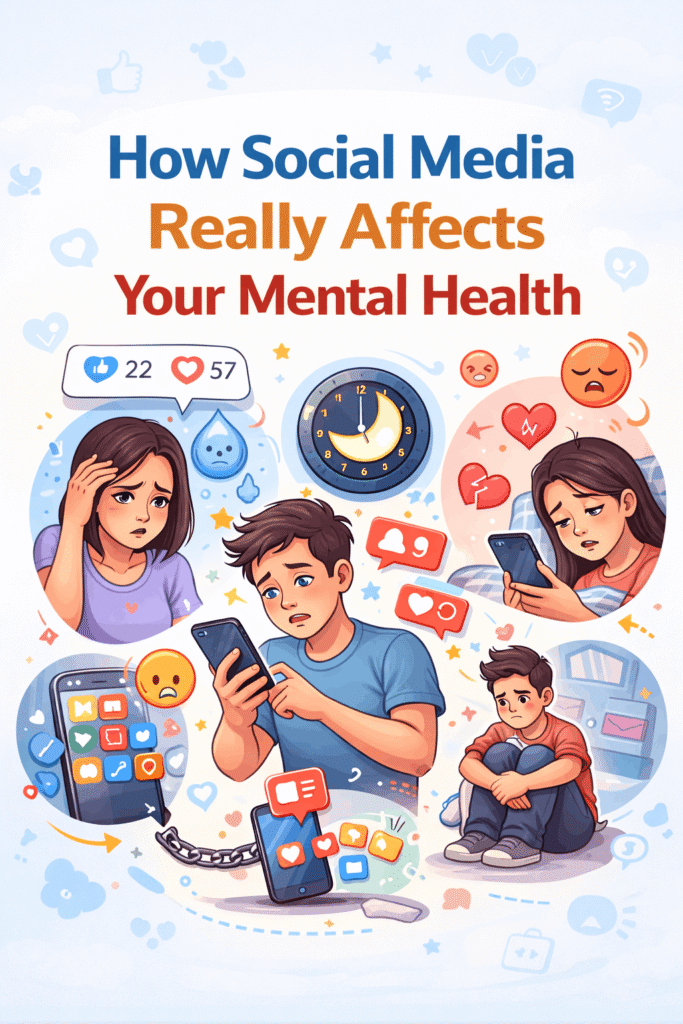
How Social Media Really Affects Your Mental Health (In Simple Words)
Let’s be real for a moment.
Social media is everywhere now. We wake up and check it. We scroll during breaks. Before sleeping — we scroll again. It has become part of our routine without us even noticing.
And honestly, there’s nothing wrong with that.
But the problem starts when we use it too much — or when we don’t even realize how it’s affecting us.
Sometimes social media doesn’t harm us suddenly. It works slowly. Quietly. And we don’t notice the change in our mood, confidence, or focus.
So let’s talk about this in a simple way.
1. Comparing Yourself Without Realizing
Most people only post the good parts of their lives.
Vacation pictures. Promotions. Happy selfies. Celebrations.
You don’t see their bad days. Their stress. Their failures.
But when you scroll for a long time, your brain starts thinking:
“Why is everyone doing so well?”
“Why is my life not like this?”
And slowly, you start feeling like you’re behind.
That constant comparison can lower your confidence. You may start doubting yourself for no real reason.
The truth is — you’re comparing your real life to someone else’s highlight reel.
2. Feeling Restless and Anxious
Have you ever picked up your phone without even thinking?
Notifications, likes, comments — they give your brain small bursts of excitement. It feels good for a moment.
But when this keeps happening all day, your mind stays in a constant alert mode.
You may feel:
- A little restless
- Slightly anxious
- Unable to relax properly
- Like you need to check your phone again
This may not feel serious at first. But over time, it increases mental stress.
3. Trouble Focusing
Short videos. Quick posts. Endless scrolling.
Your brain gets used to fast content. Everything becomes quick and entertaining.
Then when you try to study, read a book, or do deep work — it suddenly feels boring.
You lose focus faster. You get distracted easily.
It’s not because you’re lazy.
It’s because your brain has been trained to expect quick stimulation.
4. Poor Sleep
This one is very common.
You lie down in bed thinking, “I’ll scroll for 5 minutes.”
Suddenly, 45 minutes are gone.
The bright screen and interesting content keep your brain active. It becomes harder to fall asleep.
Poor sleep leads to:
- Low energy
- Mood swings
- Irritation
- Less productivity
And the cycle repeats the next day.
5. Feeling Lonely — Even with Many Online Friends
You might have hundreds of followers.
But real emotional connection is different.
Online interaction cannot fully replace:
- Face-to-face conversations
- Deep talks
- Genuine laughter
- Physical presence
If you spend too much time online and less time with real people, loneliness can slowly grow.
Humans need real connection.
6. Negative Comments Hurt More Than We Think
Sometimes one bad comment stays in our head longer than ten good ones.
Online criticism or trolling can affect:
- Self-esteem
- Confidence
- Emotional stability
This is especially true for teenagers and young adults.
Even if you tell yourself “It doesn’t matter,” deep inside it may still hurt.
7. Losing Control of Time
This is probably the biggest issue.
You open social media for 10 minutes.
One hour passes.
It becomes easy to:
- Spend more time than planned
- Delay important work
- Feel uncomfortable without your phone
- Check social media right after waking up
If social media starts controlling your time and emotions, that’s a sign you may need a small break.
Is Social Media Always Bad?
No.
Not at all.
Social media can:
- Help you stay connected
- Teach you new skills
- Provide useful information
- Give emotional support through communities
It becomes harmful only when the usage is uncontrolled.
The key word here is balance.
What You Can Do to Protect Your Mental Health
You don’t need to delete everything.
Just be more mindful.
Here are some simple steps:
✔ Set a time limit
Decide how much time you want to spend daily.
✔ Turn off unnecessary notifications
Not every notification deserves your attention.
✔ Avoid scrolling before sleep
Try keeping your phone away at least one hour before bed.
✔ Spend more time offline
Talk to friends. Go outside. Meet family.
✔ Take small breaks
If you feel mentally tired, take a few days off from social media.
Even short breaks can reset your mind.
Final Thoughts
Social media is a tool.
It should serve you — not control you.
If you use it consciously, it can be helpful.
If you use it mindlessly, it can slowly affect your mental peace.
So next time you open an app, ask yourself:
“Am I using this, or is this using me?”
Your mental health is more important than likes, comments, or followers.
⚠️ Disclaimer:
This article is for general awareness only. If you experience long-term anxiety, depression, or emotional distress, please consult a mental health professional.