Let’s have a serious, heart-to-heart talk about something most of us are afraid to even mention: Cancer. The biggest challenge with cancer isn’t always the disease itself, but the fact that it often plays a game of hide-and-seek. In the beginning, the symptoms can be so subtle—so “normal”—that we tend to brush them off as just being tired or getting older. By the time the signs become impossible to ignore, the disease has often progressed further than we’d like.
But here is the empowering truth: Your body is a great communicator. Long before things get critical, your body usually starts sending out “little smoke signals” to tell you something is wrong. If you can learn to read these signals and act on them early, the chances of successful treatment and a full recovery are incredibly high.
In this guide, I want to walk you through the common early symptoms of cancer. These aren’t meant to scare you, but to give you the knowledge you need to take charge of your health.
A Very Important Note Before We Start
I want you to take a deep breath. Just because you see a symptom on this list does not mean you have cancer. Most of these signs can be caused by much simpler, non-serious health issues like infections or common cysts.
However, there are three “Golden Rules” to keep in mind. You should definitely see a doctor if a symptom:
- Persists: It doesn’t go away after 2 or 3 weeks.
- Progresses: It’s getting worse over time.
- Resists: It doesn’t get better with standard over-the-counter medicine.
Now, let’s look at what you should keep an eye on.
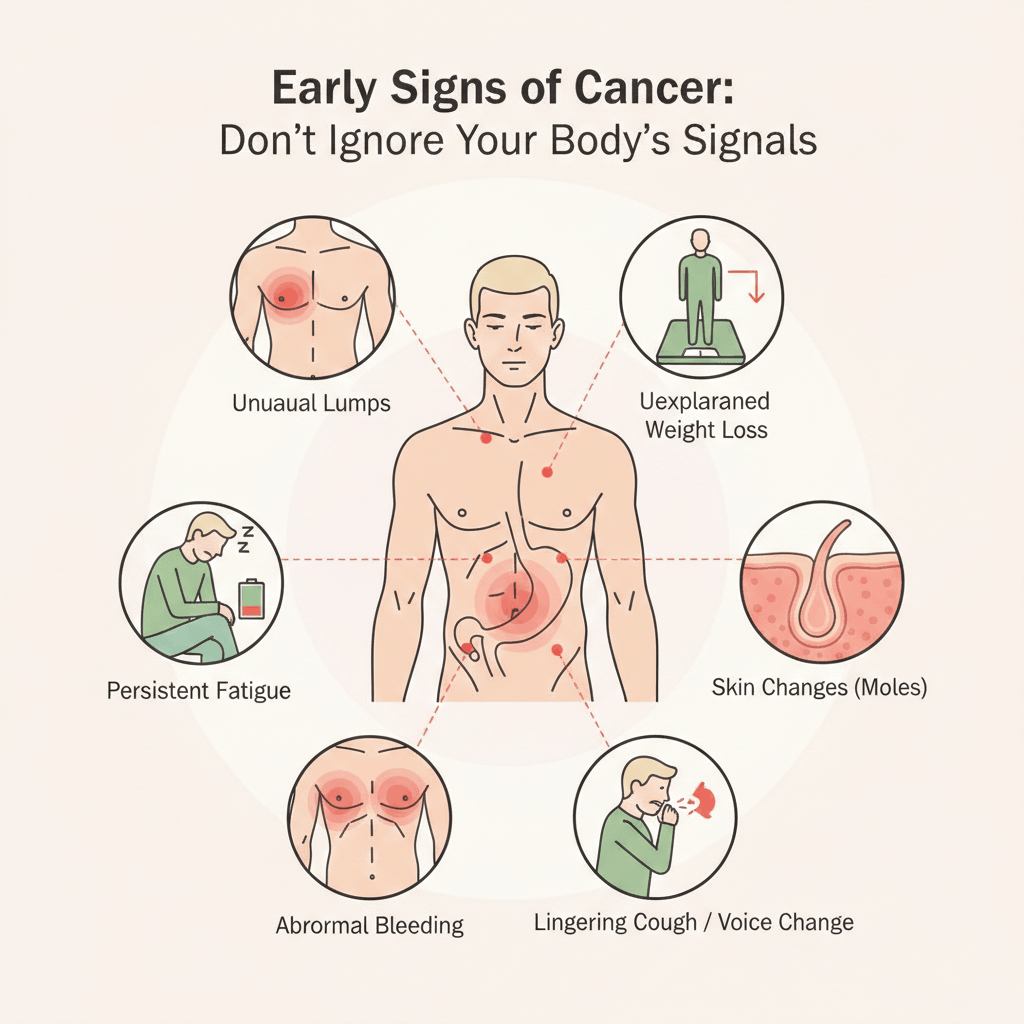
1. Unusual Lumps or Swelling
This is perhaps the most well-known sign. If you feel a new lump, a hard knot, or an unusual swelling under your skin, don’t just wait for it to disappear. Pay close attention to areas like:
- The breasts (for both men and women).
- The neck or throat.
- Under the armpits.
- The groin area.
A lump that is painless, hard, and doesn’t move easily is something a doctor should definitely check out.
2. Unexplained Weight Loss
We all love the idea of losing a few pounds, but if you notice that the numbers on the scale are dropping rapidly without any change in your diet or exercise routine, take notice.
Losing 10 pounds (5 kg) or more unexpectedly is often one of the first signs of cancers involving the pancreas, stomach, or lungs. Your body might be burning extra energy as it tries to fight off abnormal cell growth.
3. Persistent Fatigue and Weakness
We all get tired after a long day at work. But there is a difference between “busy tired” and “cancer fatigue.”
If you find yourself feeling completely drained and weak even after a full night’s sleep, or if you’re too tired to do simple daily tasks, it’s a red flag. In the early stages of some cancers, the body uses up its energy stores to deal with the disease, leading to a deep exhaustion that rest just doesn’t fix.
4. Sores or Ulcers That Won’t Heal
Our bodies are usually great at repairing themselves. If you have a cut or a sore that hasn’t healed after several weeks, it needs professional attention. Keep a special eye on:
- Sores inside the mouth or on the tongue (especially for those who smoke or drink).
- Skin ulcers that bleed or crust over but don’t close up.
5. Abnormal Bleeding or Discharge
This is one sign you should never, ever ignore. Any blood coming from a place where it shouldn’t be is a signal to see a doctor immediately. Examples include:
- Blood in your urine or stool.
- Coughing up blood or blood in your vomit.
- Unexplained vaginal bleeding between periods or after menopause.
While these can often be caused by things like hemorrhoids or infections, it’s vital to rule out anything more serious.
6. A Cough That Won’t Quit (or a Hoarse Voice)
A cough from a cold or flu should clear up in a week or two. If you have a dry, hacking cough that lingers for more than three weeks—or if your voice becomes hoarse and stays that way—it’s time for a check-up. This is particularly important for people who have a history of smoking.
7. Changes in Digestion and Swallowing
Our digestive habits can change occasionally, but long-term changes are worth investigating.
- Difficulty Swallowing: Feeling like food is “stuck” in your throat.
- Persistent Heartburn: Severe indigestion that doesn’t go away with antacids.
- Bowel Changes: Long-term diarrhea, constipation, or a change in the size of your stool.
8. Changes in Your Skin
Take a good look at your skin. Are there any moles, freckles, or warts that are changing? Doctors use the “ABCDE” rule for moles:
- Asymmetry (one half doesn’t match the other).
- Border (blurred or jagged edges).
- Color (changes in shade or multiple colors).
- Diameter (larger than a pencil eraser).
- Evolving (changing in size, shape, or starting to itch/bleed).
9. Persistent Pain
Pain is the body’s way of saying “Help!” If you have a specific pain—like a headache that won’t go away, or a dull ache in your bones or abdomen—that persists for weeks despite treatment, don’t just “tough it out.”
Why Early Detection is the Real Game-Changer
I know that talking about these symptoms can feel a bit scary. But here is the positive side: Knowledge is your best defense.
When cancer is caught in its earliest stage:
- Treatment is simpler: You might avoid aggressive surgeries or heavy chemo.
- Control is easier: You can stop the cancer before it spreads to other organs.
- The Survival Rate is Huge: For many cancers, the survival rate at Stage 1 is over 90%.
Awareness isn’t about being paranoid; it’s about being your own best health advocate.
When Is It Time to Call the Doctor?
You don’t need to run to the clinic for every little sneeze. But you should definitely book an appointment if:
- Any of the symptoms mentioned above last longer than 3 weeks.
- The symptom is interfering with your ability to eat, sleep, or work.
- You just have a “gut feeling” that something isn’t right. Trust your intuition!
Final Thoughts
Early symptoms of cancer are often quiet and easy to ignore. They don’t always scream; sometimes they just whisper. By paying attention to these whispers, you give yourself the best possible chance at a long, healthy life.
Don’t let fear keep you from the doctor’s office. Fear is a small price to pay for the peace of mind that comes with a clean bill of health—or the life-saving benefit of an early diagnosis.
Stay safe, stay aware, and take care of yourself!
⚠️ Disclaimer: This article is for general health awareness only and is not a substitute for professional medical advice, diagnosis, or treatment. If you have any persistent symptoms or health concerns, please consult a qualified physician immediately.